
Table of Contents
- Understanding Water Heater Replacement in Studio City, California
- Water Heater Basics: Types, Lifespan, and Efficiency
- Tankless vs. Traditional: Choosing the Right Water Heater for Your Home
- The Water Heater Replacement Process: From Signs to Completion
- Upgrading to Tankless or Gas Water Heaters: What You Need to Know
- Common Questions About Water Heater Replacement in Studio City
Understanding Water Heater Replacement in Studio City, California
For homeowners in Studio City, knowing when to consider water heater replacement is essential to maintaining a comfortable home and avoiding unexpected breakdowns. Water heaters are often out of sight, but as they age, they lose efficiency, drive up energy bills, and can even cause significant water damage if a leak develops.
Several clear signs indicate it’s time for a new unit. If your water heater is over 10 years old, you may notice rust-colored water from your taps or inconsistent water temperature during showers. Rumbling or popping noises from the tank often mean sediment buildup—a problem accelerated by the hard water common in the Studio City area—has damaged the unit’s internal components. A leaking tank is an urgent signal that water heater replacement shouldn’t be postponed; once the tank fails, the next step is rapid water damage.
Upgrading to a modern system offers meaningful advantages. According to the ENERGY STAR program, certified high-efficiency water heaters can reduce your energy bills by up to 10–50% compared to older, standard models. For many families, a tankless water heater installation provides on-demand hot water and saves space, while a gas water heater installation can lower operating costs and deliver quick recovery times. The right choice depends on your household’s water usage, available space, and energy priorities—factors a trained professional can evaluate.
As a family owned and operated company with over 15 years of experience, our HVAC company in Studio City offers the guidance you need. We are available for you any time of the day or night to provide a quick, professional service. You can count on us to provide you with a system and solution that fits your family’s unique needs. Once you’ve decided to replace, we’ll walk you through the straightforward process from selection to final inspection—ensuring your new water heater performs reliably for years to come.
Water Heater Basics: Types, Lifespan, and Efficiency
Choosing a new system for your home is a significant decision. Understanding water heater basics can help you make informed choices when it comes time for a water heater replacement. We understand that navigating the different technologies and efficiency ratings can feel overwhelming, so we’ve put together a clear guide to the fundamentals. Our goal is to provide you with the knowledge you need to evaluate your options with confidence.
Common Types of Water Heaters
Today’s homeowners have several technologies to choose from, each with a distinct method for generating hot water. The most common systems include:
- Conventional storage tank water heaters: These units heat and store a large volume of water, typically 30 to 80 gallons, in an insulated tank, keeping it ready for use on demand.
- Tankless (on-demand) water heaters: Instead of storing hot water, these wall-mounted units heat water directly as it flows through the device when a tap is turned on. A professional tankless water heater installation in Studio City can provide a continuous supply of hot water.
- Heat pump (hybrid) water heaters: These systems don’t generate heat directly. They use electricity to move heat from the surrounding air into the water tank, making them up to two to three times more energy-efficient than standard electric models.
- Solar water heaters: These systems use roof-mounted solar panels to capture the sun’s energy for heating water, significantly reducing reliance on utility-provided electricity or gas.
The choice between gas and electric models impacts operational costs. For example, a gas water heater installation in Studio City is common, as natural gas often proves to be more cost-effective for heating large quantities of water on demand.
Understanding Water Heater Lifespan
How long an appliance lasts depends heavily on its type, usage patterns, and the consistency of its maintenance. Proper care is the single most effective way to maximize your investment’s longevity. On average, you can expect the following life expectancies under normal conditions:
- A standard storage tank water heater typically functions reliably for 8 to 12 years.
- A well-maintained tankless unit can often last for 20 years or more.
- A heat pump water heater generally has an average lifespan of 10 to 15 years.
Factors such as water quality, the frequency of maintenance tasks like flushing, and the quality of the original installation play a critical role in whether a unit reaches the upper end of these ranges. This is why proper sizing and installation are critical for efficiency from day one.
Decoding Energy Efficiency Metrics
When comparing models, energy efficiency is measured using standardized ratings. The previous standard, the Energy Factor (EF), has largely been replaced by the more rigorous Uniform Energy Factor (UEF). According to the Air-Conditioning, Heating, and Refrigeration Institute (AHRI), which certifies a vast majority of North American equipment, the UEF provides a more accurate representation of real-world performance by simulating daily hot water usage patterns. A higher UEF signifies a more efficient water heater. The most efficient models earn the government-backed Energy Star certification, which signifies that a product meets strict performance criteria established by the U.S. Environmental Protection Agency.
With these basics in mind, we can now explore best practices for installation and maintenance. Your water heater is a vital part of your home’s overall comfort system, and scheduling regular HVAC maintenance in Studio City can help catch issues early and keep everything running efficiently.
Tankless vs. Traditional: Choosing the Right Water Heater for Your Home
When it’s time for a water heater replacement, the decision between a traditional tank and a tankless system can feel overwhelming. Both technologies offer distinct advantages, and the right choice hinges on your household’s hot water demands, budget, and long-term efficiency goals. To help Studio City homeowners navigate this comparison, we’ve outlined the key factors below.
| Feature | Traditional Tank Water Heater | Tankless Water Heater |
|---|---|---|
| Initial Cost | Lower, typically $400–$900 installed | Higher, typically $1,000–$3,000 installed |
| Lifespan | 10–15 years | 20+ years |
| Energy Efficiency | Energy Star certified models available; standby losses occur | Up to 34% more efficient than standard tanks; no standby losses |
| Space Requirement | Large floor footprint; requires ventilation clearance | Wall-mounted; saves valuable floor space |
| Hot Water Availability | Limited to tank capacity; can run out during high demand | Continuous on-demand supply; flow rate may limit simultaneous uses |
| Maintenance | Annual flushing recommended; anode rod replacement every 3–5 years | Annual descaling to prevent mineral buildup; filter cleaning |
Actual costs vary; contact us for a personalized quote.
Traditional Tank Water Heaters: Pros and Cons
A conventional storage water heater keeps a reservoir of hot water ready at all times, typically holding 40 to 60 gallons. When you turn on a tap, hot water is drawn from the top of the tank while cold water enters the bottom to be heated. This design provides a steady supply for moderate use, and the initial purchase and installation costs are generally more budget-friendly for most households.
One major advantage is simplicity—tank heaters are a proven technology with widely available replacement parts. However, they do consume energy continuously to maintain the stored water temperature, resulting in standby heat loss. Space can also be a concern, as the unit requires a dedicated floor area with proper ventilation clearance. To keep a tank heater running efficiently, we recommend annual flushing to remove sediment and inspecting the anode rod every three to five years. Without this routine maintenance, tank corrosion can shorten the unit’s lifespan significantly.
Tankless Water Heaters: Pros and Cons
Tankless systems, also known as on-demand water heaters, heat water only when you need it. Cold water travels through a heat exchanger, which is activated by flow, so there is no storage tank and no standby energy loss. This design can achieve efficiency gains of up to 34% over traditional tanks, and the units themselves often last 20 years or more.
Because tankless heaters are compact and wall-mounted, they free up valuable floor space—ideal for smaller Studio City homes or garages where every square foot counts. The primary limitation is flow rate: a unit can only heat a certain volume of water per minute. Running two showers and a dishwasher simultaneously may exceed a single unit’s capacity, so proper sizing is essential. Our team can help you calculate the peak demand for your household and recommend a model that won’t leave you with a cold surprise.
Efficiency Comparison and Operating Costs
When evaluating long-term value, energy factor ratings and annual operating costs become critical. According to Energy Star, Energy Star certified products meet rigorous efficiency benchmarks that can translate into noticeable utility savings. Tankless water heaters, in particular, eliminate standby losses entirely, making them up to 34% more efficient than standard tank models under typical usage patterns.
For homeowners planning a water heater replacement, the higher initial cost of a tankless unit may be offset by lower monthly energy bills over its extended lifespan. The Air-Conditioning, Heating, and Refrigeration Institute (AHRI) provides performance certification data that helps compare real-world efficiency. While actual payback periods depend on local utility rates and household usage, a professional load calculation can give you a clearer picture. We encourage Studio City residents to request an assessment tailored to their specific needs.
Installation Considerations for Studio City Homes
Installing a new water heater—whether tankless or traditional—involves more than just swapping out the old unit. A tankless water heater installation often requires upsizing the gas line to handle higher BTU demands, and power-vented units need proper exterior venting rather than a simple atmospheric chimney. Electric tankless models may require a dedicated 120V outlet, so an electrical evaluation is essential. Even a gas water heater installation for a larger tank may call for updated venting or gas piping.
In Studio City, all water heater replacements must comply with local building codes and typically require a permit. Our experienced technicians handle every aspect of the project—from load calculations and venting design to permit coordination and final inspection—ensuring the job meets safety and performance standards. As a family owned and operated business, we understand that reliable hot water is non-negotiable. Contact us today for a free consultation, and remember that we are available for you any time of the day or night to discuss your options or schedule service.
The Water Heater Replacement Process: From Signs to Completion
Understanding when a water heater replacement is necessary can prevent disruptive breakdowns and costly emergency repairs. In Studio City, the water heater replacement process requires careful evaluation of your unit’s condition, local codes, and available efficiency upgrades. Our family-owned team at Studio City AC Repair Experts has helped hundreds of homeowners navigate this decision, and we’re here to walk you through every step.
Signs You Should Replace Your Water Heater
Your water heater often gives early warning signs before a complete failure. Look for these five indicators:
- Rusty water: Brown or reddish water from hot taps signals internal tank corrosion, which cannot be repaired and will eventually cause a leak.
- Unusual noises: Popping or rumbling sounds come from sediment buildup hardening at the bottom, reducing efficiency and stressing the tank.
- Leaks around the tank: Any moisture or pooling near the base indicates a crack or faulty seal; even small leaks can cause major water damage.
- Inconsistent water temperature: If the water runs hot then cold unexpectedly, the heating element or thermostat may be failing, often a sign of aging components.
- Age exceeding 10 years: Most storage-tank water heaters have a useful life of 8–12 years; any unit over 10 should be evaluated for replacement to avoid sudden failure.
When you notice any of these signs, it’s time to consider a replacement rather than risking further damage or unsafe operation.
Repair vs. Replacement: Making the Call
Deciding between repairing and replacing your water heater hinges on a few key factors. The 50% rule is a practical starting point: if the repair bill is less than half the cost of a new unit, a fix may be worthwhile; if it exceeds 50%, replacement is usually the better long-term choice. Age matters too—units older than 10 years lose efficiency and are more prone to repeated failures. According to Energy Star, new certified water heaters are 20–30% more efficient, which can lower your utility bills.
| Decision Factor | Repair | Replace |
|---|---|---|
| Unit Age | Under 8 years – may be worth repairing | Over 10 years – replacement recommended |
| Cost of Repair vs. Replacement | Less than 50% of replacement cost – repair may be viable | Repair exceeds 50% of new unit cost – replace |
| Efficiency | Older models lose efficiency; repair restores function only | Newer models offer 20–30% efficiency gain and Energy Star options |
| Warranty | Limited to part and labor for the repair | Full manufacturer warranty and potential labor warranty from installer |
| Future Reliability | Likely more breakdowns as unit ages | New unit provides years of reliable service |
Energy Star certified water heaters deliver 20–30% greater efficiency than standard models. — ENERGY STAR (U.S. EPA)
Just as regular furnace maintenance keeps your heating system efficient, professional care ensures your new water heater performs optimally. Our technicians can assess your specific situation and provide a no-obligation quote, helping you decide with confidence.
The Replacement Timeline: What to Expect
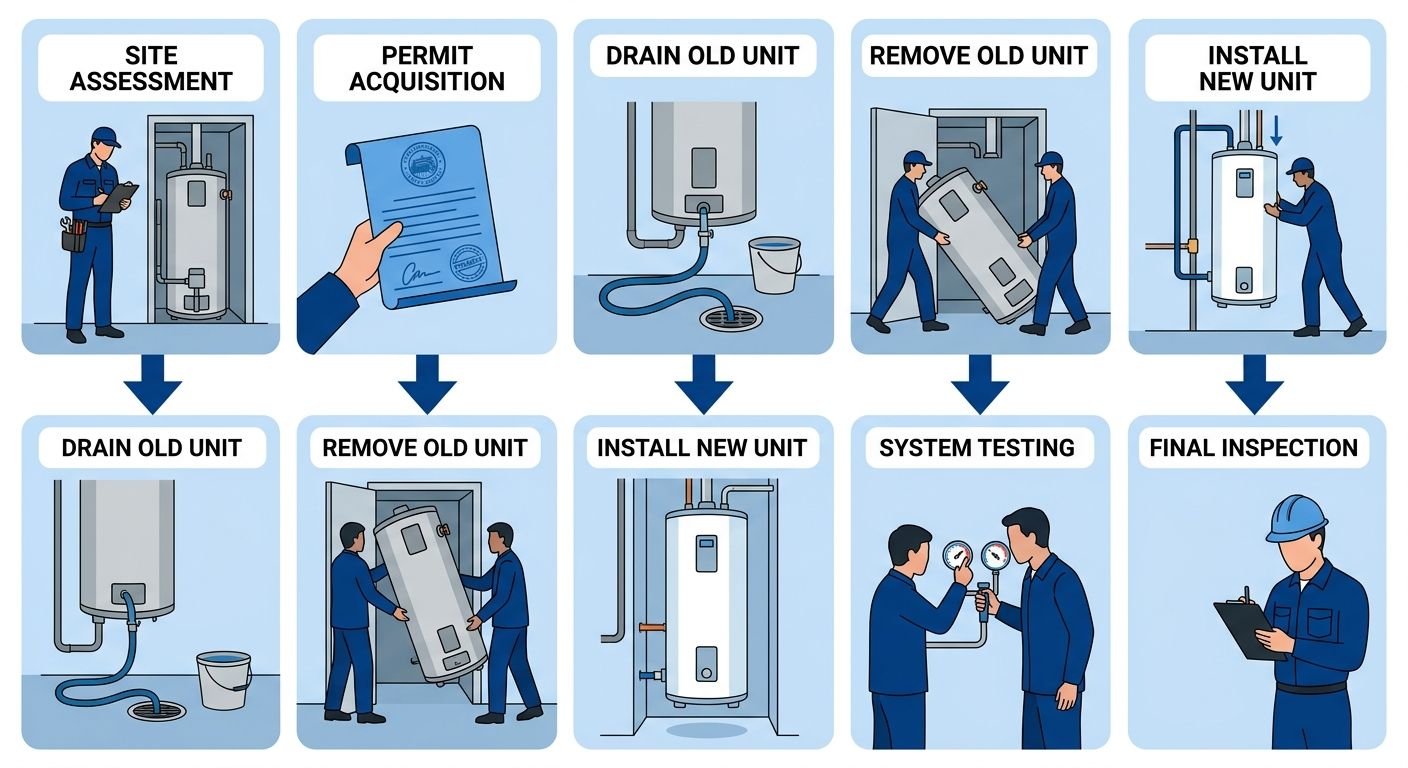
Once you’ve decided to replace, understanding the typical sequence helps you plan. Here’s what a professional water heater replacement in Studio City looks like:
- Site assessment: We inspect your existing setup—tank condition, gas line size, electrical capacity, and venting.
- Permit filing: Our team handles all required city permits for gas or electrical modifications.
- Drain and removal: The old tank is drained, disconnected, and safely hauled away.
- New unit installation: We position the new water heater, secure seismic strapping, and connect all lines.
- System testing: We fill the tank, power the unit, and confirm steady hot water and thermostat accuracy.
- Final inspection: Our technicians verify code compliance and document the completion.
Most replacements finish within one business day, assuming permit approval and no hidden complications. You won’t need to juggle multiple contractors—we manage every phase.
Complete water heater replacement process from start to finish
Permits and Professional Installation in Studio City
Water heater replacements in Studio City require city permits for any gas or electrical modification. Skipping permits can void insurance and cause home-sale complications. We handle the entire permitting process—from filing to final inspection—so every connection meets code.
Professional installation also provides:
- Code compliance: Seismic strapping, proper venting, and all California codes.
- Warranty protection: Most brands require licensed installation to keep the warranty valid.
- Safety: For gas water heater installation or tankless water heater installation, correct gas line sizing and electrical work prevent hazards.
- Peace of mind: As a family-owned and operated company, we stand behind our work and can be there fast if needed.
Once permits are secured, we’ll be ready to handle your replacement from start to finish.
Upgrading to Tankless or Gas Water Heaters: What You Need to Know
Deciding on a water heater replacement is a significant home improvement choice that affects daily comfort and long-term energy usage. Many Studio City homeowners are now evaluating high-efficiency models to replace aging units. Understanding the differences between on-demand and storage technology is the first step toward making a confident decision.
A tankless system heats water only when you turn on the tap, eliminating the standby energy losses of a traditional tank. Gas storage models, by contrast, keep a reservoir hot and ready at all times. According to Energy Star, certified gas water heaters, both tank and tankless, meet strict federal efficiency criteria that can help households reduce energy consumption. Choosing a tankless water heater installation often appeals to those seeking a compact, wall-mounted design, while a gas water heater installation can provide high recovery rates for families with simultaneous hot water needs. The right fit depends on your household size, usage patterns, and existing fuel connections.
Upgrading to gas or tankless equipment typically requires a thorough professional assessment. Our team evaluates gas line capacity, venting pathways, and electrical loads to confirm your home can support the new system safely. With over 15 years of experience, we have guided countless neighbors in Studio City through this process and understand the local code requirements that apply here. Because we are a family owned and operated business, we treat every project with the care we would give our own home, and we are available for you any time of the day or night should an unexpected issue arise during your upgrade.
Performance ratings carry more weight when they are backed by independent verification. We rely on products that carry AHRI equipment certification, which confirms that efficiency and output claims have been validated by an industry authority. Pairing AHRI-certified equipment with Energy Star guidelines helps you compare models accurately and select a unit that aligns with your comfort goals. Our trained technicians can explain these ratings in plain language and recommend a system that fits your family’s unique needs.
A professional water heater upgrade delivers quick, professional service and lasting reliability. Contact us today for a free custom quote and let our experienced team handle every detail of your replacement project.
Common Questions About Water Heater Replacement in Studio City
Now that you understand the key factors for water heater replacement in Studio City, let’s address some common questions. Most standard units last 10–15 years, so if your unit is over a decade old, it may be time to plan for an upgrade. Warning signs like rust-colored water, strange noises, or inconsistent temperatures often signal a failing system that should be evaluated promptly.
Choosing between tank and tankless water heater installation depends on your home’s layout and hot water needs. A tankless unit provides on-demand heating, longer life, and energy savings, but professional sizing is essential. We can help you assess your home and connect you with qualified professionals who perform tankless water heater installation.
A gas water heater installation demands proper venting and gas line assessments. Local codes in Studio City may require permits, so professional input is essential. As a family owned and operated HVAC expert, we can guide you through these details and offer a custom consultation. If you have more questions or need a custom quote, contact us—we are available for you any time of the day or night.