

Table of Contents
- Navigating HVAC Labor Rates: What You Need to Know
- What Drives HVAC Labor Rates Per Hour?
- Residential vs. Commercial Labor Rates: Key Differences
- Seasonal Variations and Regional Differences in HVAC Labor Rates
- Maximizing Value: Understanding the Cost Beyond Hourly Rates
- Frequently Asked Questions About HVAC Labor Rates
- Making Informed Decisions About HVAC Labor Rates
Navigating HVAC Labor Rates: What You Need to Know
When homeowners in Studio City, CA search for HVAC labor rates per hour, they usually want to understand what that hourly charge includes. It isn’t just time on the job: it reflects a technician’s training, specialized tools, vehicle upkeep, and insurance, all bundled into the service you receive. Understanding that value helps you evaluate quotes fairly and avoid surprise costs down the line.
We bring a personal, neighborly perspective to this topic. As a family-owned business with deep roots in Studio City, we have served our community for over 15 years. Our team works around the clock to handle any cooling or heating need. Over the years, we’ve learned how Studio City’s mix of older and newer homes creates unique labor demands, a factor that can influence the time needed for a repair. Because every home’s system is different, we never quote a job sight-unseen. We visit your property, diagnose the issue, and prepare a transparent, custom quote that matches your specific repair or installation.
The real story behind an hourly rate involves the technician’s specialized training, the urgency of the call, the complexity of your equipment, and even the season. Let’s take a closer look at what shapes those costs.
What Drives HVAC Labor Rates Per Hour?
Now that you have a grasp on HVAC service pricing, you may wonder what causes differences in costs between various providers. The biggest factor behind hourly labor costs is a provider’s overhead. They include insurance, professional licensing, service vehicles, and diagnostic equipment. The combined total of these expenses normally determines the lowest price a provider can charge for service.
Our technicians undergo continuous training and hold manufacturer-specific certifications. Their diagnostic accuracy and workmanship can reduce the likelihood of callbacks, and that expertise is reflected in the labor charge.
We provide emergency service and can be dispatched quickly. Emergency service requires that we be available 24/7 and can involve after-hours, weekend, or holiday call-outs that demand immediate dispatch, overtime staffing, and extra logistics. The complexity of the service or equipment can impact pricing as well. A full system design or electrical integration requires more time and advanced skill, and that can be reflected in the per-hour cost.
In the San Fernando Valley, steady demand for HVAC services and the general cost of doing business—from wages to facility overhead—push the baseline. Having served Studio City for more than 15 years, we’ve learned to absorb those pressures and provide straightforward, transparent estimates.
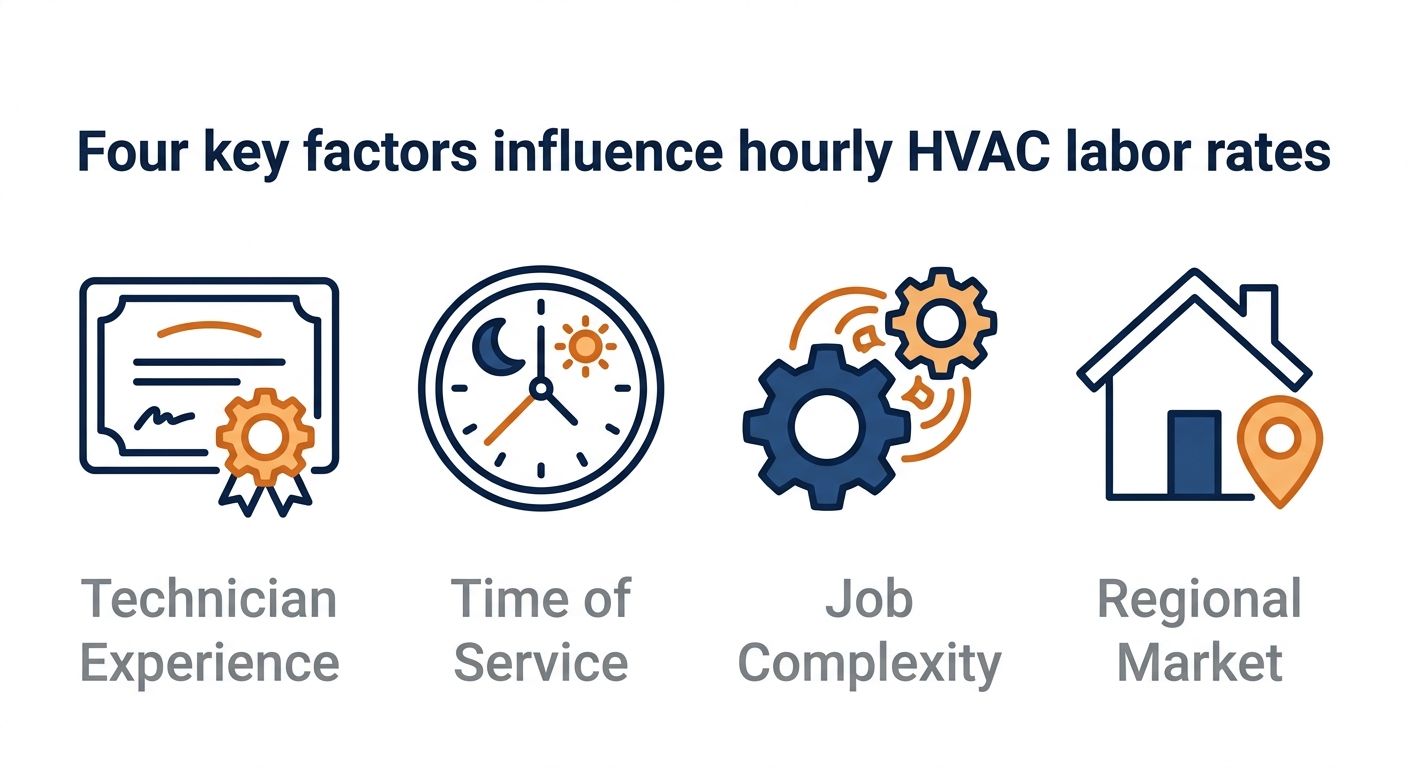
Four key factors that influence HVAC per-hour pricing
Each of the drivers of the labor rate, shown in the table below, frequently act in combination to produce the final rate.
| Factor | Description | Impact on Rate |
|---|---|---|
| Technician Experience & Training | Hands-on experience and manufacturer certifications increase diagnostic accuracy and workmanship. | Moderate increase |
| Time of Service (After-Hours/Emergency) | Calls outside regular hours require immediate dispatch, overtime staffing, and specialized availability. | Higher for emergency call-outs |
| Job Complexity & Scope | System design, electrical integration, or custom maintenance plans demand advanced skills and more time. | Varies with scope |
| Regional Market Conditions (Studio City, CA) | Local cost of living, permitting, and strong demand in the San Fernando Valley shape baseline costs. | Reflects local market |
In practice, the way these drivers play out differs between residential and light-commercial projects. A home AC repair in Studio City will involve a different mix of labor factors than a commercial system overhaul. Understanding that distinction sets you up to ask the right questions when you request a custom quote, and it points naturally toward the kind of service approach that fits your situation.
Residential vs. Commercial Labor Rates: Key Differences
There are many cost drivers that make up the hourly HVAC rate for a single family home and for a multi-tenant office building. Understanding these cost drivers in Studio City, for example, helps property owners in that area calculate the costs to provide air conditioning during the hot summer months. The following is a comparison of some of those cost drivers.
| Aspect | Residential Service | Commercial Service |
|---|---|---|
| Typical hourly labor rate | Lower, consistent | Higher, variable |
| Pricing/billing structure | Predominantly flat rate | Mix of flat rate and time-and-materials |
| System size and job complexity | Smaller split systems, furnaces | Larger tonnage, multi-zone units |
| Regulations, permits, and scheduling | Occasional local permits | Code compliance, permits, after-hours |
Residential HVAC Labor Rates: What Homeowners Pay
In Studio City and the surrounding areas, the single family homes have the more traditional and less complex air conditioning and heating systems. These systems and parts are more readily available, making job scopes more predictable and keeping per-hour service rates more stable. Also, most homeowners pay a diagnostic or service call fee for the first visit, and then an hourly labor charge for the time the technician spends diagnosing and/or repairing the equipment.
Being a family owned and operated business serving the neighborhood, we find residential jobs benefit from shorter service windows and fewer regulatory hurdles. Equipment is smaller, ductwork is often simpler, and replacement parts are generally on hand at local supply houses. These factors reduce labor time and help keep hourly charges more consistent for routine maintenance and straightforward repairs. We also explain that the diagnostic fee will be credited if further work is not conducted.
Commercial HVAC Labor Rates: Higher Costs and Complexities
HVAC units on commercial properties such as retail stores and offices tend to use larger equipment and systems. These require longer diagnostics and specialized tools. For this reason, technicians have to be trained and certified more than the average HVAC technician, and often requires scheduling and coordination with building management and compliance with local codes, which ultimately increases the cost.
The higher cost is also affected by greater liability exposure and refrigerant handling protocols. As mentioned before, many commercial repairs need to be done after hours to minimize disruption to tenants. As a result, after hours’ work becomes premium, and further adds to the already increased costs. The same holds true for diagnostics; the presence of complex controls and economizers, or multiple compressors, adds even more time to the total diagnostic time. This increased time ultimately increases the cost for the customer, even if the technician is billing by the hour.
Billing Structures: Flat Rate vs. Time and Materials
The way hourly work is documented on an invoice is impacted by the billing method selected. In a flat-rate method, an all-inclusive quote is provided and the hourly work is bundled into that total and not shown separately. In a time-and-materials method, an hourly rate is shown along with the hours worked and parts. This method makes the hourly rate and work shown on the invoice.
A flat-rate method is common for predictable residential work, while commercial projects often require time-and-materials or a mixed approach because complexity is harder to predict. Often, a mixture of both methods is used for commercial work. Before work begins, a written proposal is provided that outlines the methodology, diagnostic fees, and expectations. The method used for billing is not impacted by the building type alone. The season and region also impact hourly rates charged.
Seasonal Variations and Regional Differences in HVAC Labor Rates
Beyond building type and job complexity, seasonal demand and local geography add another layer to the cost structure of HVAC services. Understanding these patterns helps homeowners in Studio City plan ahead and make informed decisions about scheduling repairs and maintenance.
How Seasons Affect Hourly Labor Rates
Seasonal demand is one of the strongest influences on per-hour service rates. During a San Fernando Valley heat wave, cooling systems run non-stop and breakdowns multiply, creating a surge in calls that tightens technician availability. That supply-and-demand pressure naturally lifts the market cost of HVAC labor during summer peaks, just as winter cold snaps do when heating systems fail. This is a standard market response — driven by the simple fact that more households need immediate help at the same time.
Emergency and after-hours premiums become more frequent during extremes, reflecting the urgency of a midnight AC failure or a furnace that quits on a holiday weekend. We offer 24/7 emergency repair to meet that need, and our technicians are prepared to respond whenever a system goes down. Holiday and weekend call-outs all contribute to higher hourly labor costs during peak seasons.
Regional Rate Comparisons: Studio City and Los Angeles
Across the LA metro market, per-hour HVAC labor rates tend to run above state and national averages, reflecting the higher cost of doing business in Southern California. Within that broad picture, neighborhoods like Studio City, Sherman Oaks, and Burbank sit in a market where local factors can fine-tune the final number on your invoice.
Building age is a common variable: an older Studio City home with a decades-old central air system may require more diagnostic time or access challenges that influence the overall labor bill, even if the base hourly cost falls within a typical local range. System type, duct configuration, and even street-level access can shift what you ultimately pay. Because every home is different, the most accurate picture of your expected labor cost comes from a custom quote tailored to your equipment and the scope of the work. We encourage you to reach out to us for an exact estimate based on your specific situation.
Strategic Timing for Maintenance Savings
Homeowners who have some flexibility can reduce their total labor cost by scheduling routine maintenance and non-urgent repairs during the spring or fall shoulder seasons. During these off-peak months, demand cools and per-hour premiums moderate, which means a tune-up or a minor repair often costs less than the same job during a July heat wave or a January cold snap.
Our maintenance plans are designed to smooth out HVAC expenses across the year, making it easier to keep your system in peak shape without absorbing a large seasonal spike. Off-peak scheduling also tends to open up more flexible appointment windows and allows our technicians to work with a bit more breathing room. That flexibility often allows us to deliver the quick, professional service our customers expect, without the rush that peak-season emergencies can create, not as a guaranteed response-time promise, but as a practical benefit of quieter days.
It is worth remembering that the hourly rate is only one piece of the cost picture. The overall value of a service call also depends on thorough diagnostics, quality parts, and the workmanship we bring to every job. For a precise quote tailored to your home’s needs and the timing of your call, contact us directly.
Maximizing Value: Understanding the Cost Beyond Hourly Rates
In Studio City, where HVAC demand shifts with the seasons, a per-hour labor rate is only the starting point for what you will actually pay. A full service quote includes several line items that, together, determine the true cost of your repair or installation.
A transparent quote from our team breaks down the cost into the diagnostic fee, labor at the hourly rate, parts and materials, refrigerant and specialty supplies, and permits or after-hours surcharges as needed. The table below shows each component and what it covers:
| Cost Component | Typical Range | What It Covers |
|---|---|---|
| Diagnostic / Service-Call Fee | Varies; often waived or credited when repair is approved | System evaluation and diagnosis |
| Labor | Depends on system and repair complexity | Hourly rate × estimated time |
| Parts and Materials | Varies by brand and part availability | Replacement components with standard markup |
| Refrigerant and Specialty Supplies | Determined at inspection; depends on system size and age | AC recharge, line-set work, and handling of cooling fluids |
| Permits and After-Hours Charges | Quoted up front; applies when local codes or scheduling require | Permit fees and surcharges for evenings, weekends, or holidays |
For an exact, itemized quote for your Studio City home, request a custom estimate: we provide line-by-line detail without hidden surprises. We never hide fees or surprise you with charges you didn’t agree to. Transparency is how we build trust.
Focusing on the hourly rate alone won’t show you the total value of the service. Instead, compare the itemized quote and the expertise behind it. With 15-plus years of family-owned experience, trained technicians, and the ability to handle both HVAC and electrical work under one roof, our custom quotes present every detail so you can make a confident decision.
You can count on us to provide you with a system and solution that fits your family’s unique needs.
Frequently Asked Questions About HVAC Labor Rates
Many homeowners in Studio City ask what goes into the hourly labor rate on an estimate.
Why do hourly HVAC labor rates vary between companies?
Rates vary because each company carries its own licensing, insurance, and overhead costs. Technician training, years of experience, and 24/7 availability shape the per-hour figure we quote.
What does the hourly rate typically include?
We include diagnosis, standard labor, and trip expenses. Because every system is different, we provide a custom quote tailored to your home in Studio City.
How can I get an accurate rate for my home in Studio City?
Schedule a free in-home assessment. We’ll review your equipment and deliver a custom labor estimate for your home in the Los Angeles area.
Understanding what drives the per-hour figure helps you compare estimates for your home in Studio City.
Making Informed Decisions About HVAC Labor Rates
Before you compare hvac labor rates per hour in Studio City, consider job complexity, job scope and the rules of supply and demand in your local market. Experience shows, a written quote, which is itemized to clearly distinguish labor from materials, is the fairest way to present pricing. Make sure your technician has the proper credentials and fully understand the job scope before work begins. If a charge is unclear, let us know and we’ll make it clear. Our team has proudly served Studio City for over 15 years and provides 24/7 emergency HVAC and electrical service. Call (818) 643-3794 for a quote or to learn more about our maintenance plans.
Request Your Custom Quote
Now that you understand how HVAC labor rates per hour are shaped by technician expertise, job complexity, and seasonal demand, the next step is securing a personalized quote for your Studio City home. Our company has been serving the local community for over 15 years, with trained technicians available 24/7 for emergency service. We offer transparent, itemized estimates that break down labor, parts, and any additional fees so you know the total before we begin. Rather than relying on generic rate charts, a custom quote based on your specific system ensures the most accurate pricing. You can reach us at (818) 643-3794 to schedule a consultation or ask about our maintenance plans. We take pride in delivering honest, reliable service to Studio City, California homeowners every day.