
Your Studio City air conditioner just failed, and the technician has given you two paths: fix it or replace it. The right choice comes down to five things: what broke, how old the system is, what refrigerant it uses, how often it has failed before, and whether it ever kept the house comfortable. This guide walks through each one so you can make the call with facts, not pressure.
Start with what actually failed
Some failures are routine repairs on almost any system. Others are expensive enough that they change the whole conversation.
| What failed | Usually | Why |
|---|---|---|
| Capacitor, contactor or fuse | Repair | Small electrical parts that wear out on any AC |
| Thermostat or wiring | Repair | Low cost and doesn’t affect the rest of the system |
| Clogged condensate drain or float switch | Repair | A cleaning job, not a part failure |
| Condenser fan motor or blower motor | Usually repair | Common motor replacements on systems in good shape |
| Refrigerant leak at an accessible fitting or valve | Often repair | Depends on where the leak is and the refrigerant type |
| Leaking evaporator or condenser coil | Weigh both | A major part; age and refrigerant decide it |
| Compressor | Weigh both, often replace on older systems | The most expensive part of the outdoor unit |
If the failure is in the top half of the table, repair is almost always the sensible move. If it’s in the bottom half, keep reading.
Check the age on the data plate
The outdoor unit has a data plate with the model and serial number. The manufacture date is usually printed there or encoded in the serial number, and the manufacturer’s website or your technician can decode it. Also check your paperwork for the installation date.
Age matters for two reasons. Parts on an older system keep wearing out, so one repair is often followed by another. And newer equipment is generally more efficient, so a replacement can lower your cooling costs in a hot San Fernando Valley summer. Age alone isn’t the answer, though. A well-maintained older system with a small failure can still be worth fixing.
Find out which refrigerant it uses
The refrigerant type is on the same data plate.
- R-22 (often labeled HCFC-22): Production and import of R-22 ended in the U.S. on January 1, 2020. Service now depends on recovered and recycled supply. A leak or a compressor failure on an R-22 system is a strong reason to replace.
- R-410A: Still serviceable and widely used in existing systems. Repairs make sense when the rest of the system is sound.
- R-454B or R-32: These are the lower-impact refrigerants used in many newer systems. Our R-454B refrigerant guide explains the change.
Look at the repair history
One repair in several seasons is normal wear. A string of repairs is a pattern. Before you decide, list what has been fixed in the last few seasons. If the same system keeps needing coils, motors or refrigerant top-offs, the next repair is less likely to be the last one.
Topping off refrigerant repeatedly is a special warning sign. Refrigerant doesn’t get used up. If it keeps running low, there’s a leak, and adding more doesn’t fix it.
Ask whether it ever worked well
Some systems were never right. Rooms that stay hot, long run times, a humid feel indoors, or one floor much warmer than the other can point to an undersized unit or duct problems. Repairing that system restores it to a level that wasn’t good enough in the first place. A replacement is a chance to size the equipment correctly and fix the ducts.
Get the numbers you need from the technician
You can only compare repair and replacement if you have the same information for both. Ask for:
- A written repair quote that names the failed part and the labor
- What else the technician noticed during the visit, such as a weak capacitor or a dirty coil
- A written replacement quote with the equipment size, refrigerant type and what’s included (removal, permit, electrical work, line set, thermostat)
- Whether the repair would be covered by any remaining equipment warranty
If you want to understand how the first visit is billed, read our post on how HVAC diagnostic fees work.
When to repair, and when to replace
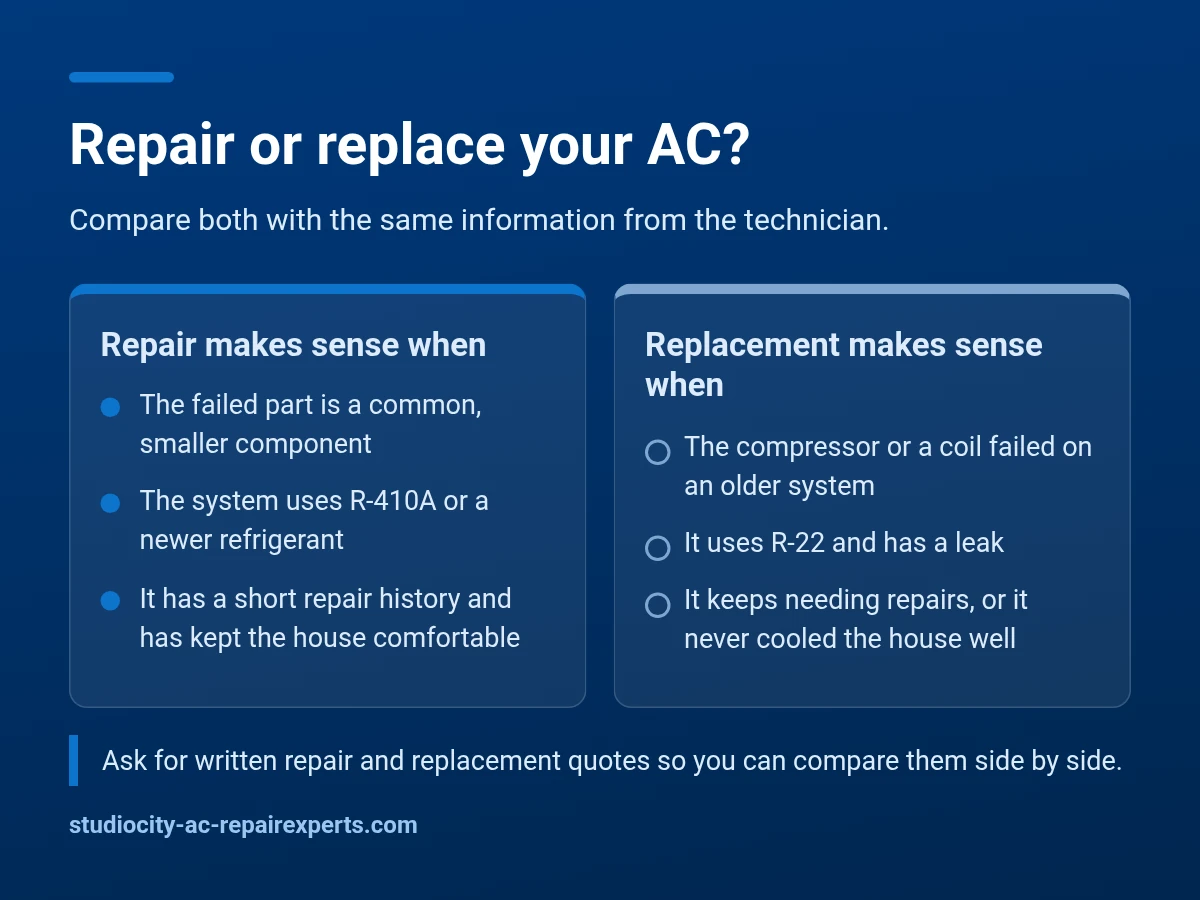
Repair makes sense when:
– The failed part is a common, smaller component
– The system uses R-410A or a newer refrigerant
– It has a short repair history and has kept the house comfortable
Replacement makes sense when:
– The compressor or a coil failed on an older system
– It uses R-22 and has a leak
– It keeps needing repairs, or it never cooled the house well
If you’re replacing, it’s also a good time to compare a new central AC with a heat pump that heats and cools. Our heat pump installation guide for Studio City homes covers that option.
Frequently asked questions
Is it worth fixing an AC compressor?
On a newer system with a sound coil and an R-410A or newer refrigerant, it can be. On an older system, or one that uses R-22, a compressor failure is usually the point where replacement makes more sense.
Can I keep using an R-22 system?
Yes, as long as it runs and doesn’t leak. Repairs that need refrigerant are harder to justify because R-22 is no longer produced or imported. Plan for a replacement rather than waiting for a summer breakdown.
How do I know a replacement quote is the right size?
Ask how the size was chosen. A proper quote is based on a load calculation for your home, not just the size of the old unit. If the old system never kept up, matching its size repeats the problem.
Should I replace the indoor and outdoor units together?
In most cases, yes. The indoor coil and outdoor unit are designed to work as a matched pair, and newer refrigerants need compatible equipment. Ask your technician if your existing indoor coil can be reused.
Should I get a second opinion?
For a major repair or a replacement, a second written quote is reasonable. It helps you confirm the diagnosis and compare what’s included.
Get a clear diagnosis first
Studio City AC Repair Experts can tell you what failed and give you both options in writing. See our AC repair and AC installation and replacement services. Visit us at 12196 Ventura Blvd, Studio City, CA 91604, or call (818) 643-3794.